
Columbia South Carolina
Landscape Architect
Columbia, SC Landscape Architect for Developers, Civil Engineers, Architects, and Contractors
Who Hires a Columbia Landscape Architect — and What They Actually Need
Most professional project teams hiring a landscape architect in the Columbia market aren’t looking for design creativity. They’re managing a permit timeline. They need a licensed firm that can produce compliant, coordinated drawings without creating delays — a firm that already knows the City of Columbia’s Landscape & Tree Ordinance, understands how Richland and Lexington County review cycles differ, and can hand off permit-ready documents that slot directly into a civil or architectural set without extra back-and-forth.
Evergreen Design Group has been that firm for developers, civil engineers, architects, and design-build contractors in the Columbia Midlands since 2005. We hold South Carolina Landscape Architect Certificate of Authorization #412, and our landscape architects are individually licensed by the South Carolina Board of Landscape Architectural Examiners. Every drawing we deliver is sealed by a licensed professional and formatted to coordinate with your civil and architectural packages from the first submission.
We operate exclusively B2B. We don’t take homeowner or residential client work. Every resource — every hour of drafting time, every staff assignment, every permit coordination call — goes toward professional project teams working on real development projects. If you’re a civil engineer, architect, land developer, or design-build contractor with a Columbia-area project, that’s the context we work in every day.
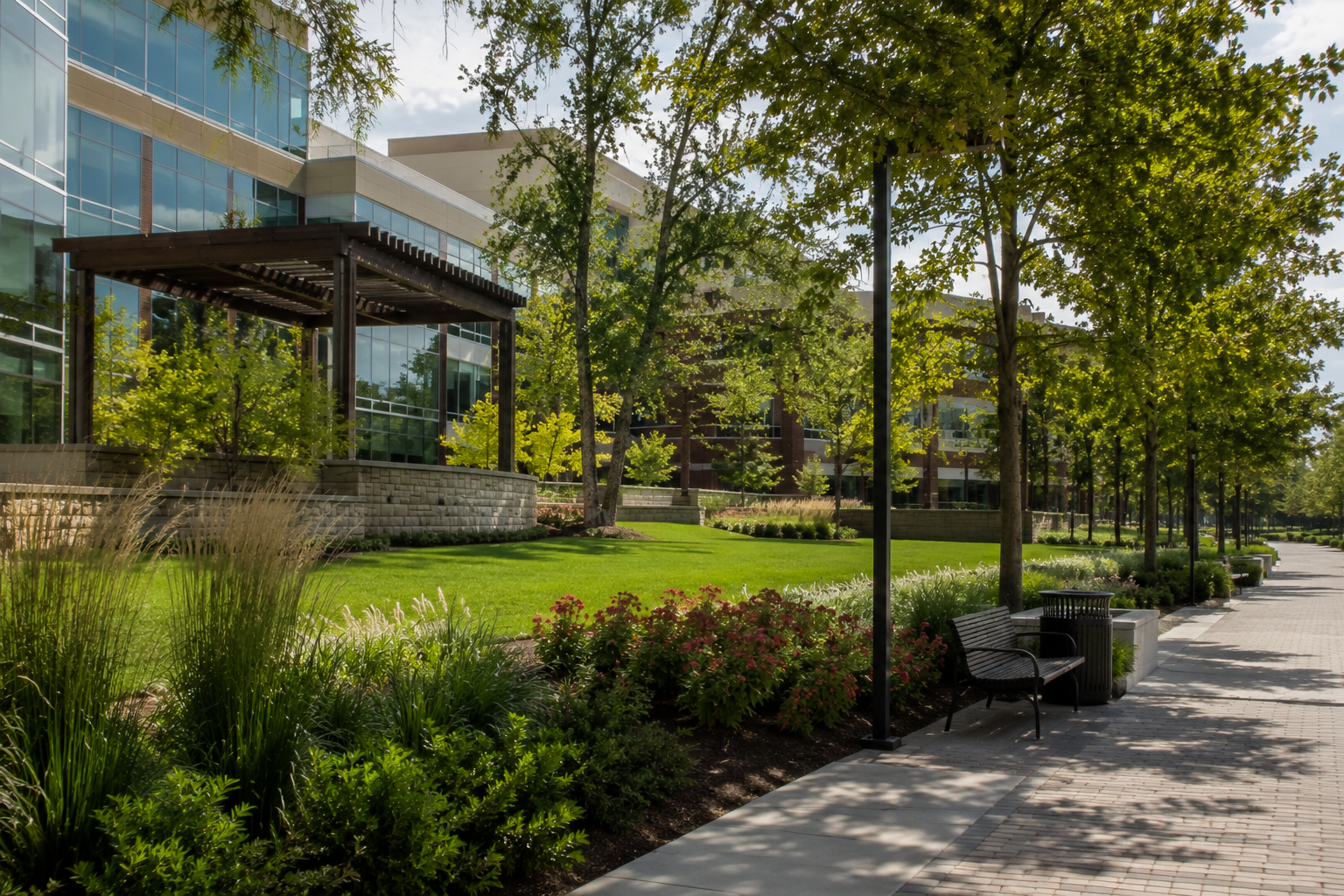
Landscape Architecture Services We Provide in Columbia, SC
All services are delivered in-house. There are no subcontractors and no handoffs between firms. Your project team has a single licensed point of contact from concept through permit-ready deliverables.

Site analysis, conceptual layout, grading coordination, and code-compliance review for the full range of project types we encounter in the Columbia Midlands: residential subdivisions in Blythewood and northeast Richland County, commercial developments along the Two Notch Road and Harbison corridors, industrial parks in West Columbia and Cayce, mixed-use projects in the Vista and Main Street districts, and institutional campuses throughout Richland and Lexington counties.
We engage at the earliest design phase — before civil grading is finalized — so that landscape improvements, stormwater features, and buffer requirements are incorporated into the site plan rather than added after the civil set is locked. Late-stage landscape integration is what creates conflicts between grading, utilities, and planting areas that require drawing revisions and re-submittals.

Sealed planting plans meeting the City of Columbia’s Landscape & Tree Ordinance requirements, including plant schedules with botanical names, sizes, quantities, and installation specifications. Our Columbia planting palettes use species appropriate for the Midlands’ sandy loam over clay soil profile and humid subtropical climate — material that performs through spring saturation and late-summer drought without requiring intensive replacement or maintenance cycles.
We maintain an updated working knowledge of the City’s approved plant list and flag proposed species that reviewers are likely to challenge before the submittal goes in, not after the first review comment comes back.

Tree survey, disposition mapping, and mitigation design for projects subject to the City of Columbia’s tree ordinance requirements. We conduct field surveys, develop CAD-based tree survey exhibits, calculate caliper-inch replacement obligations under the City’s formula, and design replacement planting locations that coordinate with the civil grading and utility plans.
Tree disposition is frequently on the critical path for Columbia permit approvals. Columbia’s Planning & Development Services won’t issue a land disturbance permit until the tree disposition plan has been reviewed and approved. We schedule this scope early and staff it accordingly.

Efficient, code-compliant irrigation design for commercial and multifamily sites throughout the Columbia metro. We design systems that account for Columbia’s seasonal rainfall variability — heavier spring precipitation followed by late-summer drought stress — and for the clay subsoil’s effect on infiltration and root zone moisture. Our irrigation drawings are formatted for direct coordination with civil and plumbing sets, using consistent sheet numbering and layer conventions.

Pool surrounds, clubhouses, outdoor gathering areas, dog parks, trails, and playground environments for residential communities and mixed-use developments throughout Richland and Lexington counties. We carry the full design scope from conceptual layout through permit-ready construction documents, coordinated with your architect’s building package and the civil site plan.

Entry monuments, plazas, pavilions, site walls, fencing, site furnishings, and decorative water features — detailed for Columbia’s climate and soil conditions. Columbia’s thermal cycling and the freeze-thaw stress on Midlands hardscape (moderate but present) require material specifications and joint designs that account for expansion and drainage performance. Every hardscape specification we produce is calibrated to site-specific drainage conditions and long-term maintenance requirements.
Frequently Asked Questions — Columbia, SC Landscape Architecture
Does the City of Columbia require a registered landscape architect to prepare landscape plans?
Yes. The City of Columbia’s Landscape & Tree Ordinance (Article 4 of the UDO) requires that landscape plans for sites exceeding one acre be prepared and sealed by a registered landscape architect. This includes tree disposition plans, buffer planting plans, and parking lot landscape plans. The requirement applies to new development and to qualifying renovation and expansion projects. Evergreen Design Group holds SC COA #412. Our landscape architects are individually licensed by the South Carolina Board of Landscape Architectural Examiners, and we are the landscape architect of record for every drawing we deliver.
Do you work directly with architects and civil engineers, or only with property owners?
We work exclusively in a B2B capacity. Our clients are civil engineers, architects, land developers, and design-build contractors. We don’t take on homeowner or individual property owner projects. We function as a landscape architecture partner embedded in your project team — coordinating with civil, architectural, and MEP disciplines from early design through permitting and construction documentation.
What does the City's tree disposition requirement involve, and when does it apply?
The tree disposition requirement applies to any development project involving land disturbance on a site of one acre or more within the City of Columbia. A registered landscape architect must survey all qualifying trees — generally trees of 6-inch DBH or greater — within the area of disturbance, designate each tree’s disposition (preserve, relocate, or remove), and calculate the mitigation obligation using the City’s caliper-inch replacement formula. The resulting tree disposition plan must be submitted to and approved by Planning & Development Services before a land disturbance permit is issued. Failing to put this scope on the critical path early is a common cause of permit delays on Columbia development projects.
Are you licensed to practice landscape architecture in South Carolina?
Yes. Evergreen Design Group holds South Carolina Certificate of Authorization #412. Our landscape architects are individually licensed by the South Carolina Board of Landscape Architectural Examiners, and we have been actively practicing landscape architecture in South Carolina since 2005. We also hold active licenses in more than 40 states and operate nationally
What areas around Columbia do you serve?
We serve the full Columbia Midlands region, including the City of Columbia, West Columbia, Lexington, Irmo, Blythewood, Chapin, Cayce, Forest Acres, and the surrounding Richland and Lexington county communities. We also serve clients managing multi-site development programs that include Columbia among other markets.
How do you coordinate with the civil engineer during permitting?
We work within the civil engineer’s grading and drainage framework from the first design phase. Our landscape and irrigation plans are formatted to coordinate directly with civil site plan sheets — consistent layer conventions, sheet numbering, and CAD standards that minimize conflicts and RFIs during review. We track City and county review comments in coordination with the civil team and issue revised drawing sets on the same schedule. The objective is a single, coordinated permit submission — not two separate packages that reviewers have to reconcile on their end.
What is your standard process for engaging on a new Columbia project?
Engagements begin with a scoping conversation to understand the project type, site constraints, applicable ordinance requirements, and your team’s permit schedule and coordination needs. From there, we develop a scope of services aligned with your submission timeline, covering land planning, tree disposition, planting design, hardscape, and irrigation as applicable. We assign a dedicated project manager for each engagement. All drawings are delivered in formats formatted for direct coordination with your civil and architectural sets, and we remain engaged as the landscape architect of record through permitting and construction administration.
How does Columbia's soil profile affect planting and irrigation design?
Columbia’s soils present a specific design challenge: sandy loam surface profiles over a dense clay subsoil at 18 to 36 inches. The clay layer creates a perched water table during heavy spring rainfall, then restricts capillary rise during summer drought periods. Plants specified without accounting for this profile — particularly species with deep tap roots or those intolerant of periodic saturation — fail within the first two growing seasons. Irrigation systems designed for standard infiltration rates will over-irrigate during wet periods and under-deliver during dry ones. We address these conditions through species selection calibrated to the Midlands’ moisture cycle, soil amendment specifications for disturbed construction soils, and irrigation designs that account for the clay layer’s effect on water distribution and drainage.
Do you work directly with property owners, or only with professional project teams?
We work exclusively in a B2B capacity. Our clients are civil engineers, architects, land developers, and design-build contractors. We do not take homeowner projects or work directly with individual property owners. We function as a landscape architecture partner embedded in the professional project team, coordinating with civil, architectural, and MEP disciplines from early design through permitting and construction documentation.
How do you coordinate your landscape drawings with the civil engineer's set?
We engage with the civil engineer’s grading and drainage framework at the conceptual design phase — before the civil set is locked. Our landscape and irrigation plans are produced using the same CAD standards, layer conventions, and sheet numbering as the civil package, so that our drawings integrate with yours rather than running as a separate package that reviewers have to reconcile. We track review comments from City and county staff in coordination with the civil team and issue revised drawing sets on the same schedule. The goal is a single, coordinated submittal — not two separate packages that create questions during review.
What a Columbia SC Landscape Architect Needs to Know
City of Columbia Landscape & Tree Ordinance - What It Actually Requires
The City of Columbia's Landscape & Tree Ordinance (Article 4 of the Unified Development Ordinance) applies to all new development and qualifying expansions on sites exceeding one acre. What that means in practice:
Tree disposition requirements. Any disturbed site over one acre requires a tree disposition plan prepared and sealed by a registered landscape architect. The plan must identify all trees of 6-inch DBH or greater within the disturbance area, designate each as preserved, relocated, or removed, and establish a mitigation strategy that satisfies the City's caliper-inch replacement formula. The City's formula calculates replacement requirements based on the total caliper inches of removed significant trees against a replacement ratio — and reviewers at Planning & Development Services will reject submittals that don't account for every qualifying tree or that propose replacement species not on the City's approved plant list.
For a typical 50-acre residential subdivision in the Columbia metro, tree disposition can involve surveying 200+ individual trees, coordinating protective fencing details with the civil grading set, and specifying replacement planting locations that don't conflict with stormwater infrastructure. Getting that scope onto the critical path early — before civil grading is finalized — is what separates a clean first submittal from a second or third review cycle.
Buffer and screening requirements. The ordinance requires Type A, B, or C landscape buffers between dissimilar land uses, with specific canopy tree, understory tree, and shrub requirements for each buffer classification. Parking lots exceeding 20 spaces require internal landscaping calculated on a square-foot-per-space basis, with canopy tree placement specifications that must account for underground utilities. Loading areas, mechanical equipment, and refuse enclosures require screening that meets height and opacity standards.
Planting plan content requirements. The City requires sealed planting plans that include plant schedules with botanical names, common names, size at installation, spacing, and quantity — not just conceptual layouts. Reviewers cross-reference proposed species against the ordinance's approved plant list and will request substitutions if proposed material doesn't comply. Installers working from non-compliant plans will trigger a re-inspection cycle that delays the CO.
SC DHEC Stormwater Requirements and How Landscape Architecture Affects Them
Development projects in Columbia generating land disturbance of one acre or more must obtain a Construction General Permit from the South Carolina Department of Environmental Services (formerly SC DHEC). The permit requires a Stormwater Pollution Prevention Plan (SWPPP) and post-construction stormwater management features that meet the State's water quality volume and peak flow requirements.
Where landscape architecture directly intersects with the stormwater scope: bioswale design, rain garden sizing and planting, detention basin side-slope stabilization planting, and permeable paving systems all require coordination between the civil engineer's stormwater calculations and the landscape architect's planting and grading details. When those two scopes aren't coordinated from the start of the design process, you get conflicts — a bioswale sized for a specific drainage area that the planting plan doesn't match, or a detention basin side-slope specified at a grade that can't support the proposed seeding mix.
We engage with civil engineering stormwater design at the conceptual phase, not after the civil set is locked. That's the only way to produce landscape-integrated stormwater features that actually perform — and that pass review on the first submission.
Columbia's Soil Profile — Why It Matters for Every Scope We Touch
Columbia sits within the Upper Coastal Plain physiographic region. Surface soils in most of the metro are Cecil sandy loam to Appling sandy loam — well-draining sandy soils that support good plant establishment under normal conditions. The problem is what's underneath: a dense, low-permeability clay subsoil (predominantly kaolinite) at depths of 18 to 36 inches that is pervasive across Richland County and much of Lexington County.
That clay layer creates a perched water table during heavy rainfall events — common in Columbia's spring months — and then switches to drought stress conditions in late summer as the surface sandy layer dries out. Plants specified without accounting for this moisture dynamic fail within two growing seasons. Irrigation systems designed without accounting for the clay layer's effect on infiltration rates either saturate the root zone during wet periods or under-deliver during dry ones.
Our planting palettes for Columbia projects are built around species that perform in this specific moisture cycle: native and climate-adapted material that tolerates both periodic inundation and summer drought stress without requiring intensive maintenance. We specify soil amendment protocols that improve infiltration in disturbed construction soils, and we design irrigation schedules and head spacing to account for the clay layer's effect on water distribution.
Richland County vs. Lexington County — Different Review Processes, Different Timelines
Columbia-area development frequently spans both Richland and Lexington counties, and the two jurisdictions operate on different schedules and with different submission requirements. Richland County's Development Review process runs through the County's Planning & Development Department, while Lexington County's review goes through its own Building and Development Services office. Projects within the City of Columbia's corporate limits — regardless of county — go through Columbia's Planning & Development Services, which has its own review cycle separate from either county's process.
We've submitted and managed permit approvals through all three of these review bodies. The practical implications: Lexington County's review timeline for landscape plans has historically run shorter than Richland County's; Columbia city reviewers are more detailed in their ordinance compliance checks than county reviewers; and dual-county projects require careful tracking of which jurisdiction holds authority over which parcel when a site straddles a county line.
Climate-Resilient Design Specifications
Columbia’s humid subtropical climate — hot, humid summers with heavy spring rainfall and periodic drought conditions — creates durability challenges for both hardscape materials and plant material. We account for thermal expansion in paving specifications, surface spalling risk in material selection, and drainage performance in detail design. Planting palettes incorporate native and climate-adapted species capable of handling both saturated soil conditions in spring and drought stress in late summer without intensive maintenance intervention.
Project Types We Support in Columbia, SC

- Residential Communities — Single-family subdivisions, townhome communities, and multifamily developments throughout the Columbia metro, including master-planned communities in Blythewood, Chapin, Irmo, Lexington, and northeast Columbia. Full scope from entry corridors and buffer planting through pool amenity areas and phased build-out.
- Commercial Development — Retail centers, office parks, and mixed-use projects from downtown Columbia and the Vista to Harbison, Sandhills, and the Two Notch corridor. Ordinance-compliant landscape plans delivered on commercial development timelines.
- Industrial and Logistics Sites — Industrial park landscaping, truck court screening, perimeter buffering, and compliant planting plans for sites along Shop Road, in West Columbia and Cayce, and throughout the Blythewood and northeast Columbia industrial corridors.
- Institutional and Civic — Campus planning, greenway connections, government facility landscaping, school and university site design, and public parks across Richland and Lexington counties.
- Mixed-Use Developments — Complex sites integrating residential, retail, and civic programming into a coordinated landscape framework, from ground-plane planting through structured hardscape and amenity design.
- Healthcare and Senior Living — Accessible pathway design, wayfinding systems, therapeutic landscape features, and healing garden environments for healthcare campuses and senior living communities throughout the Columbia metro.
Why Project Teams Choose Evergreen Design Group in Columbia
One firm, full scope. Land planning, landscape architecture, tree disposition, irrigation design, and hardscape — all from one licensed firm. No subcontractors. No coordination gaps between the firm that did the planting plan and the one that did the irrigation. One project manager. One sealed drawing set.
We know the Columbia market. We’ve been practicing landscape architecture in South Carolina since 2005. The City’s Landscape & Tree Ordinance, SCDES stormwater requirements, Richland and Lexington County review processes, and the Midlands’ soil and climate conditions aren’t research items for us — they’re the standard operating environment. Firms without that background generate review comments that delay your permit.
Drawings that coordinate with your set. Our landscape and irrigation plans use consistent CAD layer conventions, sheet numbering, and drawing standards that integrate with civil and architectural packages. We don’t hand off a PDF that your civil engineer has to reconcile against the grading plan. We produce drawings that are built to coordinate from the start.
Licensed in 40+ states. Available for multi-site programs. For clients managing development programs that include Columbia among multiple markets, we hold active licenses in more than 40 states and can serve as landscape architect of record across your entire portfolio without requiring you to manage multiple firm relationships.
Partner with a Columbia SC Landscape Architect Who Knows the Market
Evergreen Design Group has been delivering landscape architecture services to professional project teams in the Columbia Midlands since 2005. We hold SC Certificate of Authorization #412, we’re licensed in 40+ states, and we work exclusively with architects, civil engineers, land developers, and design-build contractors.
If you’re working on a project in Columbia — or managing a program that includes Columbia among multiple sites — contact Evergreen Design Group to discuss your scope and timeline.
Contact us at evergreendesigngroup.com/contact-us/ or reach us directly at (800) 680-6630.
Get in Touch with Us
Ready to discuss a Columbia-area project? Complete the form below and a member of our team will follow up to discuss scope and timeline.