
Arizona Landscape Architect
Landscape Architecture Firm in Arizona
Evergreen Design Group, established in 2005, is a licensed landscape architecture firm practicing in Arizona. We hold Arizona Firm Registration 22536-0, and every service we deliver — land planning, landscape architecture, tree disposition plans, native plant inventories, water harvesting plans, and irrigation design — is performed in-house by our licensed professionals. No subcontracting of scope, no handoffs.
Our practice is exclusively B2B. We work as a coordinated subconsultant to land developers, civil engineers, architects, and design-build contractors. Our deliverables are structured for permit submittal, technical review, and direct integration with your civil and architectural scope — not for homeowners.
We’ve completed projects across the Greater Phoenix metro, the Tucson metro, Flagstaff and the Central Highlands, and secondary markets statewide. Our team brings over 160 years of combined professional experience to Arizona projects, and we understand the regulatory environment here well enough that jurisdictional nuance is built into how we work — not something we figure out after you’ve engaged us.
In Arizona, the title “Landscape Architect” is legally protected. Only professionals holding active state registration may stamp plans. Our landscape architects carry current Arizona licensure and the project experience to back it up. Licensure is maintained by the Arizona Board of Technical Registration.
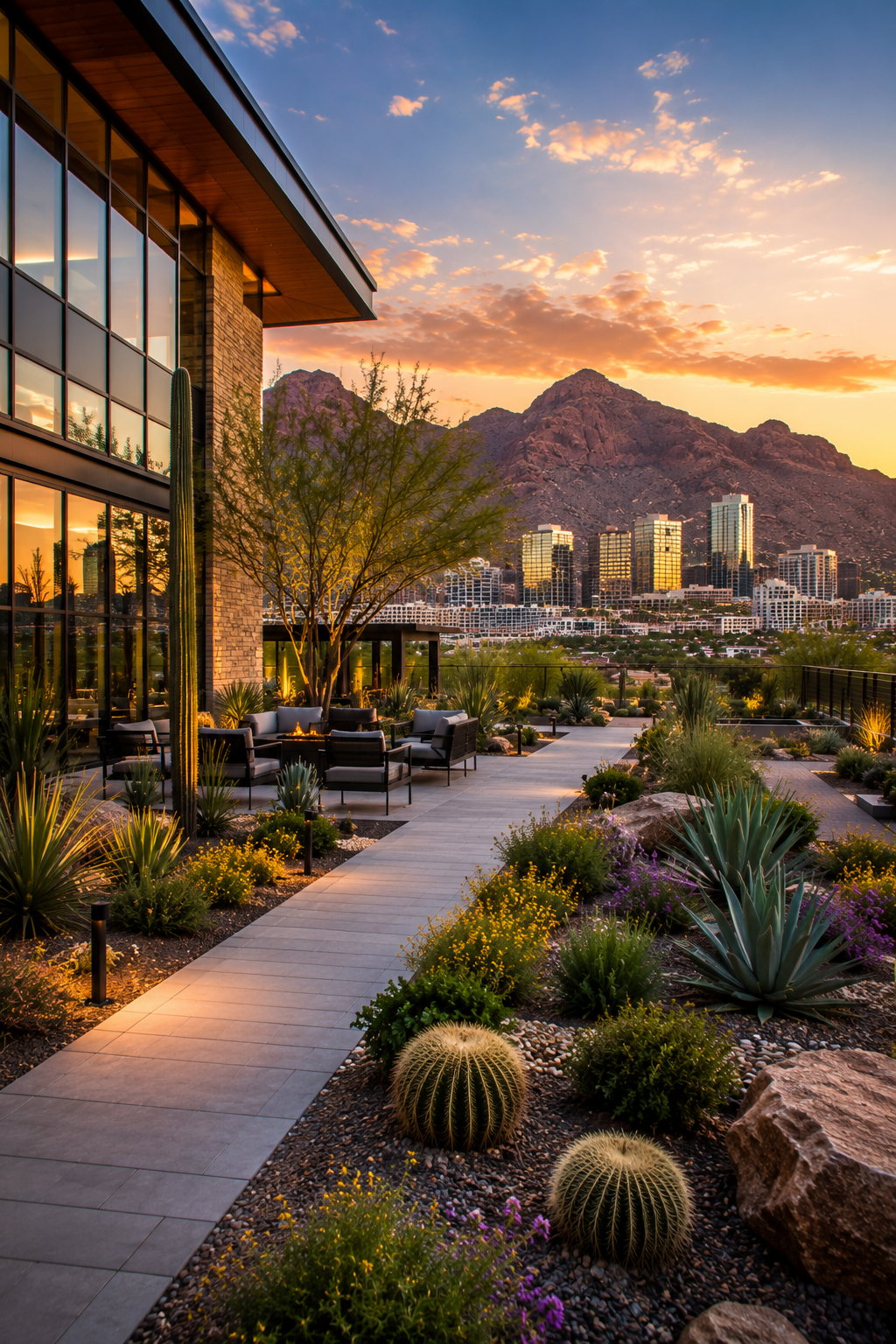
Arizona Landscape Architecture for the Development Pipeline

What distinguishes our Arizona practice isn't just the license. It's the depth of working knowledge behind it. We know how Phoenix's Development Services Department moves. We understand Scottsdale's Development Review Board process. We know where Tucson's Landscape and Screening Code diverges from Pima County's standards, and where those diverge from what Flagstaff requires. That kind of jurisdiction-specific fluency only comes from sustained project experience — which is what we have.
The landscape architects Arizona developers and civil engineers need to engage understand more than plant species. They need to understand permit submittal requirements, how ADWR Active Management Area parameters interact with municipal ordinance standards, and where the landscape scope touches the civil set in ways that create review problems if they're not coordinated early. That's the level at which we work on every Arizona engagement. .
Landscape Architecture Services in Arizona
Our team delivers fully in-house professional services across every phase of a project — from initial land planning through permit-ready construction documents.

Land planning in Arizona is more complicated than it looks from the outside. The regulatory environment varies meaningfully between jurisdictions — Phoenix, Scottsdale, Tucson, Flagstaff, and most of the state’s secondary markets each operate under their own zoning standards, development review processes, and entitlement timelines. What satisfies review in one city can create problems in the next.
Our land planning scope covers setback compliance, buffer yard requirements, open space calculations, pedestrian circulation design, native plant preservation zone integration, water harvesting basin siting, and the interface with civil grading and drainage — all coordinated with your civil engineer from the initial layout stage. Getting that coordination right early is what prevents the revision cycles that cost time and money later.
Typically, we work directly for the land developer, and sometimes as a subconsultant to civil engineering firms. Our land planning documentation is formatted for the development review process of the applicable jurisdiction — not a generic statewide standard.

Arizona’s irrigation design requirements are among the most comprehensive in the country. ADWR Active Management Area compliance, municipal water conservation ordinances, and the permit submittal documentation requirements of individual jurisdictions all need to be addressed — and they interact in ways that affect system design decisions from the outset.
Our irrigation design scope produces complete, permit-ready packages: zoned system layouts, controller and equipment specifications, flow and pressure calculations, water budget calculations, and scheduling documentation formatted for the applicable jurisdiction’s plan check requirements. We address ADWR AMA compliance as a baseline design parameter on every commercial Arizona project — not as an afterthought once the system layout is already set.

We produce permit-ready planting plans calibrated to Arizona’s distinct regional climate conditions — from the Sonoran Desert heat of the Phoenix and Tucson basins to the cooler, higher-elevation environment of Flagstaff and the Central Highlands. Species selection accounts for caliche soil conditions, alkaline pH, extreme thermal cycling, and the long-term irrigation water budgets that drive planting plan review in Arizona’s Active Management Areas.
All planting plans comply with applicable municipal landscape ordinances, xeriscape requirements, and HOA design guidelines, and are developed to minimize long-term water demand and irrigation system operating costs from the design stage forward.

We prepare comprehensive documentation of existing trees to support entitlement, grading, and permitting processes across Arizona’s municipal jurisdictions. In Arizona, tree disposition scope frequently overlaps with Native Plant Inventory requirements — protected native species subject to salvage and relocation requirements under municipal Native Plant Preservation Ordinances are often the same trees driving disposition decisions on desert development sites.
We format tree disposition documentation to meet the specific review requirements of the applicable jurisdiction — Phoenix’s Planning and Development Department, Scottsdale’s Development Review Board, Tucson’s Planning and Development Services, or other Arizona municipal review agencies. Stamped plans from a licensed landscape architect are required for significant site modifications in most Arizona jurisdictions.
Native Plant Inventory and Salvage Plans in Arizona
Phoenix, Scottsdale, Tucson, and a growing number of Arizona municipalities require Native Plant Inventories and Salvage Plans as part of the commercial development permit process. These documents identify protected native plants on the project site — saguaro, palo verde, ironwood, mesquite, and other Sonoran Desert species — assess their condition and salvage viability, and establish a disposition plan for on-site preservation, transplanting, or authorized removal.
We prepare Native Plant Inventories and Salvage Plans formatted to meet the applicable jurisdiction’s specific submittal requirements, coordinated with your grading plan and permit package.
Water Harvesting Plans in Arizona
Phoenix, Scottsdale, and other Arizona municipalities require Water Harvesting Plans for commercial and multi-family development projects above defined impervious surface thresholds. These plans demonstrate that site grading and landscape design direct a specified percentage of roof and hardscape runoff toward planted areas — reducing net irrigation demand and supporting municipal water conservation requirements.
We prepare Water Harvesting Plans as an integrated scope item alongside the civil set, formatted to meet the applicable jurisdiction’s permit submittal requirements. The critical word there is “integrated” — water harvesting basin siting and grading need to be coordinated with the civil drainage design from the beginning of the project, not added after the civil plans are finalized. We build that coordination in from day one.

We design pool surrounds, tot lots, sport courts, shaded ramadas, pavilions, outdoor kitchens, and common open spaces for multi-family residential and master-planned communities throughout Arizona. Amenity designs are developed to HOA standards, local building codes, and ADA accessibility requirements, with shade structure coverage, heat-reflective paving materials, and drought-tolerant perimeter plantings treated as standard design parameters — not optional upgrades — given Arizona’s extreme summer heat environment.

We design parking lot landscape screening, streetscapes, community courtyards, entry features, retaining walls, and structured outdoor spaces for commercial, mixed-use, and institutional projects across Arizona. Material specifications account for extreme thermal cycling, UV intensity, and the impervious surface and water harvesting basin requirements that govern commercial hardscape design under Arizona municipal ordinances. Surface drainage direction and water harvesting integration are addressed as coordinated scope items within our hardscape documentation
Arizona Landscape Architecture Regulatory Framework
Arizona’s development regulatory environment is layered and jurisdiction-specific in ways that directly affect landscape architecture scope on commercial and multi-family projects. Understanding what each layer requires — and how they interact across jurisdictions — is foundational to producing submittals that move through review efficiently.
ADWR Active Management Areas and Irrigation Design Requirements
Arizona’s five Active Management Areas (AMAs) — Phoenix, Tucson, Prescott, Pinal, and Santa Cruz — are established under the Arizona Groundwater Management Act to manage groundwater resources in the state’s most heavily developed regions. The AMA framework establishes water conservation requirements and long-term water use reduction goals that directly affect irrigation system design, landscape water budget calculations, and the xeriscape and water conservation standards that municipalities within AMA boundaries implement through their own landscape ordinances. Nearly all of Arizona’s major development markets fall within an AMA. (Arizona Department of Water Resources (ADWR).
Municipal Native Plant Preservation Ordinances in Arizona
Phoenix, Scottsdale, Tucson, Cave Creek, Carefree, and a growing list of Arizona municipalities have enacted Native Plant Preservation Ordinances requiring documentation and protection of specified native species on development sites. The scope of what must be inventoried, what qualifies for salvage versus authorized removal, and how mitigation is calculated varies meaningfully between jurisdictions. We prepare Native Plant Inventories and Salvage Plans that comply with the specific ordinance of the project’s jurisdiction — not a generic statewide standard.
Municipal Water Harvesting Ordinances — Phoenix and Scottsdale
Phoenix and Scottsdale have enacted Water Harvesting Ordinances requiring commercial and multi-family development projects to demonstrate that a specified percentage of on-site impervious surface runoff is directed toward planted landscape areas through engineered basins and grade changes. The Water Harvesting Plan is a permit submittal requirement — not an optional sustainability enhancement — and it must be coordinated with the civil grading and drainage plan to satisfy review.
ADEQ AZPDES Construction General Permit and Landscape Scope
The Arizona Department of Environmental Quality administers the AZPDES Construction General Permit program for land-disturbing activities of one acre or more. Projects requiring AZPDES coverage must prepare a Stormwater Pollution Prevention Plan (SWPPP) addressing erosion and sediment control during construction and post-construction stormwater management. Landscape architecture contributes to post-construction scope through permanent vegetative cover specifications and BMP planting documentation. We prepare these deliverables in coordination with your civil engineer of record as a standard component of our Arizona commercial project scope.
Municipal Landscape Ordinance Variation Across Arizona
Arizona’s major development jurisdictions each maintain their own landscape ordinance standards. Phoenix’s landscape ordinance and Urban Form standards differ from Scottsdale’s xeriscape requirements, Tucson’s Landscape and Screening Code, Flagstaff’s landscape standards, and the varying requirements of Mesa, Chandler, Gilbert, Glendale, Peoria, and Surprise. Designing to the wrong jurisdiction’s standard costs time in review. We bring jurisdiction-specific knowledge into the design process from the initial site planning stage.
Arizona Markets We Serve
Greater Phoenix Metropolitan Area — Maricopa County
The Phoenix metro is Arizona’s primary development market. We work on projects throughout Maricopa County under the varying landscape and development review standards of Phoenix, Scottsdale, Tempe, Mesa, Chandler, Gilbert, Glendale, Peoria, Surprise, Goodyear, Buckeye, Queen Creek, Avondale, and Fountain Hills. Direct familiarity with Phoenix’s Development Services Department and Scottsdale’s Development Review Board process — and the review frameworks of the major suburban municipalities — allows us to move efficiently through entitlements across the metro without the learning curve that slows down firms without sustained local project experience.
Tucson and the Tucson Metropolitan Area — Pima County
The Tucson metro is Arizona’s second-largest development market, and its regulatory framework differs meaningfully from the Phoenix metro. Tucson’s Landscape and Screening Code, native plant preservation requirements, and Pima County’s development standards each have their own characteristics. We work on projects throughout the Tucson metro under both City of Tucson and Pima County jurisdiction with direct knowledge of how each reviews landscape documentation.
Flagstaff and the Central Highlands
Flagstaff’s higher elevation, cooler climate, and mountain forest environment create a fundamentally different landscape architecture context from the Sonoran Desert markets. Species selection, soil conditions, stormwater management, and the regulatory framework governing development in Coconino County all differ from the lower-desert metros. We approach Flagstaff and Central Highlands projects with plant palettes and design strategies calibrated to the region’s specific climate zone — not adapted down from Phoenix-market templates.
Secondary Arizona Markets
We support development projects in Prescott and the Prescott metro, Sedona, Casa Grande, Yuma, Sierra Vista, and other secondary Arizona markets. Each operates under its own municipal and county regulatory framework, and we bring jurisdiction-specific knowledge to projects across these markets.
Project Types We Support in Arizona
- Single-family residential subdivisions and master-planned communities
- Multi-family and build-to-rent communities
- Mixed-use and town center developments
- Retail centers, pad sites, and commercial outparcels
- Office and corporate campus projects
- Industrial parks, logistics facilities, and warehousing
- Institutional and educational campuses
- Senior living and continuing care communities
- Municipal parks and civic facilities
- Healthcare and medical campus environments
- Resort and hospitality-adjacent development
Why Arizona Development Teams Work With Evergreen Design Group
Licensed, In-House, No Subcontracting
Evergreen Design Group holds Arizona Firm Registration 22536-0. All landscape architectural services for Arizona projects are performed under this registration by our licensed professionals. No subcontracting of scope means consistent quality, clear accountability, and a single point of coordination for your civil and architectural team throughout the project.
ADWR, AMA, and Municipal Ordinance Fluency
Arizona’s water conservation regulatory framework and its municipal landscape ordinance environment are more complex and jurisdiction-specific than most states. We understand the Active Management Area requirements that apply across Arizona’s major development markets and integrate landscape architecture and irrigation design scope with those requirements from the initial layout stage — not at the plan check stage when changes are expensive. American Society of Landscape Architects (ASLA) .
Native Plant Inventory and Water Harvesting Plan Experience
These are required permit deliverables on commercial and multi-family development projects across Phoenix, Scottsdale, Tucson, and a growing list of Arizona municipalities. We produce them as standard scope items coordinated with your civil grading and permit package — because treating them as add-ons creates the kind of coordination gaps that generate review comments.
Subconsultant Experience Across Multiple Arizona Jurisdictions
The majority of our Arizona engagements are structured as subconsultant relationships with civil engineering or architecture firms. We operate within your project structure, maintain consistent documentation standards across multiple jurisdictions simultaneously, and coordinate with your team throughout the design and entitlement process.
20 Years of National Practice, Arizona Market Depth
Founded in 2005, Evergreen Design Group has completed landscape architecture projects across 43 states. Our depth in Arizona — spanning the Phoenix metro, Tucson, Flagstaff, and secondary markets — is built from sustained project experience across the state’s distinct development environments, regulatory frameworks, and climate zones. Recent Arizona project experience includes commercial, multi-family, and mixed-use development across the Phoenix metro, Tucson, and the Prescott area.

Frequently Asked Questions: Arizona Landscape Architect
Is Evergreen Design Group licensed to practice landscape architecture in Arizona?
Yes. Evergreen Design Group holds Arizona Firm Registration 22536-0. All landscape architectural services for Arizona projects are performed under this registration by our licensed professionals. We have practiced landscape architecture in Arizona since 2005.
Do you work with homeowners or individual residential clients in Arizona?
No. Our practice is exclusively B2B. We serve land developers, civil engineers, architects, and design-build contractors. We do not take on individual homeowner projects.
What Arizona markets do you actively serve?
We work statewide. Active markets include the Greater Phoenix metro (Maricopa County), the Tucson metro (Pima County), Flagstaff and Coconino County, the Prescott metro, and secondary markets including Casa Grande, Yuma, and Sierra Vista.
What does land planning in Arizona involve for commercial development projects?
Land planning Arizona scope involves developing site plans, open space configurations, buffer yard layouts, native plant preservation zone integration, water harvesting basin siting, and streetscape frameworks that satisfy the applicable jurisdiction’s zoning and development review requirements. Because Arizona commercial development spans jurisdictions with meaningfully different standards — Phoenix, Scottsdale, Tucson, Flagstaff, and secondary markets each have their own requirements — land planning in Arizona requires jurisdiction-specific knowledge of the development review process that governs each specific site. Our land planning Arizona services are performed in-house and coordinated directly with your civil engineer from the initial site layout stage.
What does irrigation design in Arizona require for commercial projects?
Irrigation design in Arizona must comply with the Arizona Department of Water Resources Active Management Area requirements applicable to the project’s jurisdiction and the municipal water conservation ordinances of the project’s municipality. Required permit submittal deliverables typically include zoned system layout plans, controller and equipment specifications, flow and pressure calculations, water budget calculations, and irrigation scheduling documentation. Our irrigation design Arizona team produces permit-ready packages that address ADWR AMA compliance as a baseline parameter on every commercial project.
What is a Native Plant Inventory and when is it required in Arizona?
A Native Plant Inventory is a field survey that identifies and documents protected native plants — including saguaro, palo verde, ironwood, and other Sonoran Desert species — on a development site. Phoenix, Scottsdale, Tucson, and other Arizona municipalities require Native Plant Inventories and accompanying Salvage Plans as part of the commercial development permit process for projects affecting sites with native desert vegetation. We prepare both documents formatted to meet the applicable jurisdiction’s submittal requirements.
What is a Water Harvesting Plan and which Arizona jurisdictions require it?
A Water Harvesting Plan demonstrates that site grading and landscape design direct a specified percentage of on-site impervious surface runoff toward planted landscape areas through engineered basins and swales. Phoenix and Scottsdale both require Water Harvesting Plans for commercial and multi-family projects above defined thresholds. We prepare site-specific Water Harvesting Plans integrated with your civil grading and drainage design and formatted to meet the applicable jurisdiction’s permit submittal standards.
How does Arizona’s Active Management Area framework affect irrigation design?
Arizona’s five Active Management Areas establish groundwater management requirements and water conservation goals that translate into municipal landscape irrigation efficiency standards and xeriscape requirements across most of Arizona’s major development markets. Our irrigation design Arizona team develops designs with the applicable AMA conservation tier and corresponding municipal requirements as baseline parameters — including water budget calculations, drip and low-flow technology specifications, and smart controller documentation required for commercial permit review.
Can you serve as a subconsultant to a civil engineering or architecture firm on an Arizona project?
Yes — that is one of our most common engagement structures across the state. We integrate into your project team and deliver the full landscape architecture scope as a subconsultant, coordinating directly with your project manager and other disciplines throughout the design and entitlement process.
When should landscape architects in Arizona be engaged on a commercial development project?
As early as possible — ideally at the site planning stage, before the civil plan set is substantially developed. Early engagement allows native plant preservation areas, water harvesting basin locations, buffer yards, and municipal landscape ordinance compliance to be integrated into the site layout before those decisions are locked in. Projects that engage landscape architects Arizona development teams early consistently produce cleaner submittals and fewer revision cycles through Arizona’s development review processes.
What types of commercial projects does Evergreen Design Group handle in Arizona?
We work across commercial, multi-family residential, mixed-use, industrial, and institutional project types throughout Arizona. Common project types include retail and office development, build-to-rent and garden-style apartment communities, master-planned residential communities, hospitality-adjacent development, senior living, healthcare campuses, and industrial and logistics facilities. All work is B2B — performed for developers, architects, civil engineers, and design-build contractors.
Does Evergreen Design Group stamp plans in Arizona, or do you work under another firm's stamp?
Our Arizona landscape architects are in-house. We do not subcontract the review and sealing of our plans to a different landscape architecture firm.
Talk to Our Arizona Landscape Architecture Team
If you’re a civil engineer, land developer, architect, or design-build contractor with a project in Arizona — whether in the Phoenix metro, Tucson, Flagstaff, or a secondary market — Evergreen Design Group’s landscape architects in Arizona are ready to discuss your project scope, schedule, and team structure. As a licensed landscape architecture firm operating statewide, we’re structured to integrate into your project at the right stage and deliver permit-ready documentation that moves through Arizona’s development review processes efficiently.
Get in Touch with Us
Interested in transforming your outdoor space? Fill out the form below, and our team will get back to you soon.