
Pennsylvania Landscape Architect
Evergreen Design Group
Pennsylvania Landscape Architect Services for Developers and Design Teams
Evergreen Design Group provides licensed landscape architecture, land planning, hardscape design, amenity design, and irrigation services for land developers, civil engineers, architects, and design-build contractors working in Pennsylvania. We have been delivering technical site design and construction documentation since 2005, working on projects that require coordinated multi-discipline documentation, jurisdictional review management, and construction-ready drawing packages.
Pennsylvania’s development environment is one of the more complex in the Mid-Atlantic region — fragmented municipal review authority, rigorous DEP stormwater regulations, significant climate variability across the state, and a mix of greenfield, infill, and brownfield conditions that demand disciplined site analysis before design begins. If your project team needs a landscape architect who understands what that environment requires, that is the practice Evergreen has built.

Pennsylvania Site Conditions That Drive Design Decisions
Pennsylvania is not a uniform project environment. The state spans four distinct climate zones, multiple physiographic provinces with dramatically different soil and topographic conditions, and a municipal structure — over 2,500 municipalities with independent zoning authority — that makes Pennsylvania one of the most jurisdictionally fragmented development environments in the country. A landscape architect who approaches Pennsylvania projects without accounting for these variables will produce work that struggles through review and underperforms in the field.
Climate and Physiographic Variability Across the State
Southeastern Pennsylvania — the Philadelphia metro, Chester and Delaware counties, the Lehigh Valley — operates in a humid subtropical transition zone with hot summers, moderate winters, and year-round precipitation. The Ridge and Valley province of central Pennsylvania introduces more pronounced topographic relief, colder winters, and soil conditions shaped by the region’s geology. Western Pennsylvania and the Pittsburgh metro sit in a humid continental climate with greater cold-season severity. The Pocono plateau and northeastern highlands introduce conditions approaching montane, with frost dates, growing seasons, and soil characteristics that differ materially from the southeast corner of the same state. Planting palettes, grading strategies, and irrigation design all need to reflect where in Pennsylvania the project actually sits.
DEP Stormwater Regulations and Landscape Coordination
Pennsylvania DEP’s Chapter 102 (erosion and sediment control) and Chapter 105 (dam safety and waterway management) regulations impose meaningful constraints on site grading, drainage design, and vegetation management during and after construction. Post-construction stormwater management requirements under the state’s MS4 permit framework and municipal stormwater ordinances increasingly require landscape features — bioswales, rain gardens, detention basin planting, riparian buffer restoration — to serve dual functions: drainage infrastructure and landscape design. Evergreen coordinates with civil engineers on stormwater feature design from the start of a project, so that planting, grading, and drainage within regulated features are documented correctly and satisfy both landscape and civil plan review simultaneously.
Municipal Zoning Fragmentation
Pennsylvania’s 2,500-plus municipalities each maintain independent zoning ordinances, subdivision and land development (SALDO) regulations, and landscape standards. What satisfies landscape buffering requirements in one township may fall short in the adjacent municipality. Street tree specifications, parking lot screening standards, open space ratios, and buffer widths vary township by township. There is no single statewide landscape standard to design to — every project requires a code review specific to the municipality of record. Evergreen builds jurisdiction-specific code compliance into our standard workflow, not as an afterthought at plan check submission.
Soil Conditions and Grading Complexity
Pennsylvania’s physiographic diversity produces a wide range of soil conditions that directly affect landscape architecture decisions. The Piedmont soils of southeastern Pennsylvania are often clay-heavy with poor drainage characteristics that require careful attention to planting pit design, drainage layer specification, and grade transitions. The rocky, shallow soils of the Ridge and Valley province present different challenges for rooting depth and grading. The Allegheny Plateau soils of western Pennsylvania carry their own set of characteristics. Evergreen’s site analysis process accounts for these conditions before design begins — because a planting plan that ignores soil reality will fail in the field regardless of how well it reads on paper.
What We Deliver on Pennsylvania Projects
Evergreen carries five integrated service lines on Pennsylvania development projects. On most engagements, several of these run concurrently as a single coordinated package.

Early site organization — open space distribution, pedestrian and vehicular circulation, buffer configurations, phasing logic, and entry hierarchy — determines how well a project performs through municipal review and how efficiently it builds. In Pennsylvania, those decisions intersect with municipal zoning ordinances that vary significantly from township to township, Act 537 sewage planning requirements on sites without public sewer access, DEP Chapter 102 and 105 compliance thresholds, and riparian buffer requirements under the Clean Streams Law. Evergreen’s land planning work begins with the site’s regulatory and physical constraints, not a generic site organization template. We develop configurations that are defensible before the zoning hearing board and buildable in the field.

Our core deliverable on most Pennsylvania projects is a complete, permit-ready landscape package: grading and drainage coordinated with civil, planting plans with regionally appropriate species palettes for Pennsylvania’s varied climate zones, hardscape design, site amenity layouts, and full construction details. Drawings are CAD-based and coordinated directly with civil and architectural sets. We work across project types — master-planned communities, multifamily and mixed-use, commercial and corporate campus, and large-lot subdivisions — and across delivery methods including design-bid-build, design-build, and CM at-risk.

While Pennsylvania landscapes are not characterized by the dense urban tree canopy of wetter states, tree preservation requirements are active in many of Idaho municipalities Our tree disposition plans document existing trees by species, caliper, and condition; establish protection zones per the applicable ordinance; assess preservation feasibility relative to proposed grading; and calculate replacement obligations in the format required by the reviewing jurisdiction.

Pennsylvania’s average annual precipitation — roughly 40 to 48 inches across most of the state — does not eliminate the need for designed irrigation systems on development projects. Establishment periods, drought variability, and the water budget requirements increasingly embedded in municipal landscape ordinances all require a designed, documented, and inspectable irrigation system. Evergreen provides complete irrigation design services: system hydraulic analysis, mainline and lateral sizing, head-to-head coverage layouts, controller programming parameters, and specifications written to support contractor installation and owner operations. See our irrigation design services page for scope details and project examples.

Amenity programming is a meaningful differentiator in Pennsylvania’s competitive residential and mixed-use development markets, particularly in the Philadelphia and Pittsburgh suburban corridors where buyer expectations are high and comparable projects compete on site experience. Evergreen designs amenity environments — pools and pool decks, clubhouses and surrounding landscape zones, tot lots, dog parks, fitness courts, shade structures, seating areas, and trail connections — as integrated components of the site plan from the start. We produce full construction documentation for amenity areas coordinated with your project’s architecture, civil infrastructure, and phasing schedule. See our amenity design services page for scope details and project examples.

Paving systems, retaining walls, seat walls, plazas, entry monuments, pedestrian connections, and site furnishing layouts require precise dimensional control, material specifications, and detail drawings that hold up through contractor bidding and field installation. In Pennsylvania, hardscape specifications must account for significant freeze-thaw cycling, base preparation requirements for the region’s clay-heavy soils in many areas, and drainage integration with DEP-regulated stormwater systems. Evergreen’s hardscape documentation is fully coordinated with grading, drainage, and utility plans — conflicts are resolved on paper, not during construction. See our hardscape design services page for scope details and project examples.
Project Types We Support in Pennsylvania

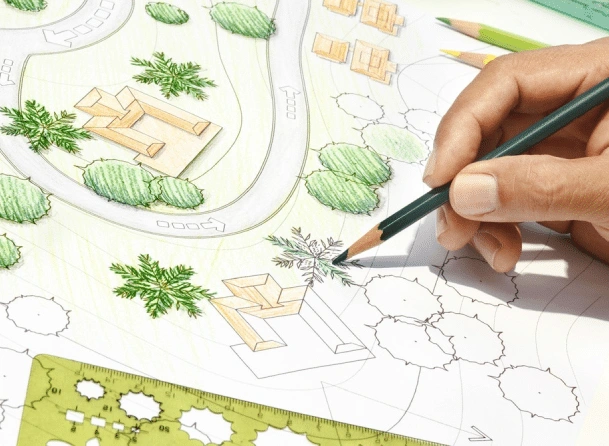
Master-Planned Residential Communities
Pennsylvania’s suburban growth corridors — the Philadelphia exurban ring, the Pittsburgh suburban expansion areas, the Lehigh Valley, and the Central PA I-83 and I-78 corridors — continue to generate large residential projects that require landscape architecture at multiple concurrent scales: master plan open space networks and trail systems, phase-level construction packages released on developer schedules, and detail-level standards for lot treatments, entry monuments, and perimeter buffering. Evergreen structures delivery to stay ahead of your construction phasing across all three scales simultaneously.
Multifamily and Mixed-Use Development
Pennsylvania’s urban cores and transit corridors — Philadelphia, Pittsburgh, and their inner-ring suburbs — have absorbed significant multifamily and mixed-use density. These projects require close coordination between landscape architecture, architecture, civil, and MEP, particularly for rooftop and podium planting conditions, structured parking integration, and streetscape design that satisfies municipal urban design standards. Evergreen’s documentation is structured for direct integration with architectural and civil sets, and our specifications are written to CSI MasterFormat for clean incorporation into project manuals.
Commercial and Corporate Campus
Commercial and corporate site development in Pennsylvania involves parking lot landscape compliance, stormwater feature integration, corporate identity planting, and ADA-compliant pedestrian circulation — all within the applicable municipal landscape ordinance. Evergreen carries these scopes within our landscape architecture services and coordinates utility and grading interfaces with civil from the start of the design process, not at plan check submission.
Large-Lot Subdivision
Pennsylvania’s rural and exurban markets continue to produce large-lot subdivision projects, particularly in Chester, Lancaster, York, and Butler counties. These projects often involve complex environmental constraints — riparian buffers, wetland adjacencies, Act 537 compliance, steep slope ordinances — that require landscape architecture and land planning expertise to navigate without creating conditions that stall approval or generate costly redesign.
How We Coordinate with Your Pennsylvania Project Team
The most common landscape architecture problem on Pennsylvania development projects is not design quality — it is coordination lag and jurisdictional surprise. Landscape drawings that do not reflect current civil grading. Planting plans submitted to a municipality whose ordinance requires species that were not on the palette. Stormwater basin planting that was never coordinated with the civil drainage design. These are preventable problems, and Evergreen’s workflow is structured to prevent them.
Our standard coordination protocol on Pennsylvania projects includes:
- Municipal code review specific to the jurisdiction of record before design begins
- Early-phase site analysis tied to the civil base to identify environmental and regulatory constraints
- Coordinated CAD file exchange with civil and architectural teams at defined milestone intervals
- Stormwater feature coordination with civil before planting plans are finalized
- Utility conflict review before hardscape and planting plans are locked
- Submittal packages structured for the specific municipality’s review process and checklist
- Construction administration support to resolve field conditions without derailing the schedule
We work as an embedded member of the project team. Direct coordination between your civil lead and our team is standard operating procedure, not the exception.
FAQ: Pennsylvania Landscape Architecture for Developers and Design Teams
Is Evergreen Design Group licensed to practice landscape architecture in Pennsylvania?
Yes. Evergreen Design Group holds landscape architecture licensure in multiple states and operates nationally. Our team is qualified to stamp and seal landscape architecture documents for Pennsylvania projects. Contact us directly to confirm applicable credentials for your specific project scope and municipality.
How does Evergreen handle Pennsylvania’s fragmented municipal zoning environment?
Every Pennsylvania project starts with a jurisdiction-specific code review. We pull the applicable zoning ordinance, SALDO regulations, and any municipal landscape standards before design begins — not at plan check submission. Buffer widths, parking lot screening ratios, street tree spacing, open space requirements, and species restrictions all vary by municipality, and designing to the wrong standard wastes everyone’s time. We structure submittals to the specific checklist and format each municipality uses, and we coordinate with plan reviewers during preliminary phases to surface and resolve comments before formal submission.
How does Evergreen coordinate landscape design with DEP stormwater requirements?
Pennsylvania DEP’s Chapter 102 and post-construction stormwater management requirements increasingly require landscape features to function as drainage infrastructure. Bioswales, rain gardens, detention basin planting, and riparian buffer zones all sit at the intersection of landscape architecture and civil engineering. Evergreen coordinates with your civil engineer on these features from the start — grading, drainage, and planting are documented as an integrated system, not as separate packages that are reconciled at the end of design.
Can Evergreen handle both entitlement-phase planning and construction documentation on the same Pennsylvania project?
Yes — and maintaining continuity across phases is intentional. The landscape architect who shaped the design intent at the planning and entitlement level is the right person producing the construction documents. Scope handoffs between phases introduce risk, particularly in Pennsylvania where municipal conditions of approval often include specific landscape commitments that need to be carried forward accurately into the CD set. We are structured to carry projects from land planning through construction administration.
What does a standard Pennsylvania landscape architecture construction document package include?
A standard CD package includes: existing conditions and demolition plan, grading and drainage plan coordinated with civil, layout and materials plan, planting plan with plant schedule, irrigation plan with hydraulic calculations, site details and specifications, and any jurisdiction-specific documentation required for municipal plan check — landscape buffers keyed to ordinance requirements, stormwater planting schedules, lighting photometrics where required. Deliverables are defined explicitly in the proposal based on project scope and the applicable review authority.
How early in the process should we bring in a landscape architect on a Pennsylvania project?
Early enough that site organization decisions are still fluid — which in Pennsylvania often means at or before the pre-application meeting with the municipality. Pennsylvania’s municipal review processes can be lengthy, and conditions imposed late in entitlement are expensive to redesign around. On projects with significant open space requirements, environmental constraints, or municipalities with detailed landscape standards, we recommend engaging at the feasibility or pre-application phase. We will tell you directly what we can and cannot affect at whatever stage you bring us in.
Does Evergreen work across all regions of Pennsylvania, or only specific markets?
Evergreen serves the full state of Pennsylvania as part of our nationally licensed practice. We work across the Philadelphia metro, Pittsburgh metro, Lehigh Valley, Central PA, and other Pennsylvania markets. Our approach to each region accounts for its specific climate zone, soil conditions, physiographic province, and the regulatory environment of the applicable municipalities. We do not apply a single-template approach to a state with Pennsylvania’s level of geographic and jurisdictional variability.
Work With a Pennsylvania Landscape Architect Who Understands the Development Process
Evergreen Design Group has been supporting development project teams since 2005. Our Pennsylvania landscape architecture practice is built around the conditions, regulations, and coordination requirements that actually govern project outcomes in this state — municipal zoning fragmentation, DEP stormwater compliance, physiographic variability, and the multi-discipline coordination demands of complex development projects.
If you have a Pennsylvania project in planning, entitlement, or design development, contact us to discuss scope. We will tell you directly what we can contribute and what engagement looks like for your specific project.
Get in Touch with Us
Tell us about your Utah project. We work with land developers, civil engineering firms, architects of record, and design-build contractors. We will follow up promptly.”