
Landscape Architects Dallas
Dallas Landscape Architecture for Developers, Engineers, and Architects
Evergreen Design Group is a licensed landscape architecture firm serving land developers, civil engineers, architects, and design-build contractors on projects across Dallas and the broader DFW Metroplex. Since 2005, we have delivered land planning, planting design, hardscape design, and irrigation design on residential communities, mixed-use developments, commercial projects, and industrial sites throughout the region.
Dallas County and the surrounding Metroplex counties — Collin, Denton, Rockwall, Kaufman, and Ellis — represent one of the highest-volume development markets in the country. The sheer pace of residential land development in the DFW Metroplex, combined with the distinct regulatory and geological conditions of the Blackland Prairie environment, creates a landscape architecture demand environment that rewards firms with genuine local expertise and the documentation capacity to keep pace with fast-moving project schedules.
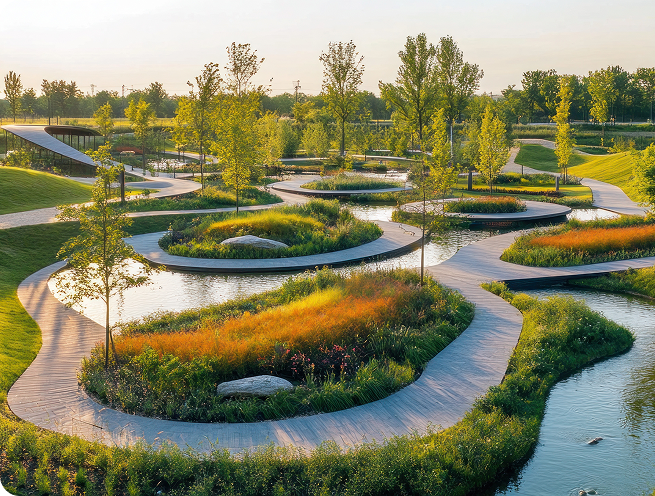
Landscape Architecture in Dallas's Development Environment
Blackland Prairie: Shrink-Swell Clay Soils — The Defining Geological Challenge
The Dallas area sits on the Blackland Prairie — a geologic formation characterized by deep, highly expansive clay soils (Houston, Austin, and Lewisville series) that expand significantly when wet and contract when dry, creating seasonal volume changes of several inches at the soil surface. This shrink-swell behavior is the single most important geological factor for landscape architects designing in Dallas: it causes chronic movement in hardscape pavements, retaining walls, and edge restraints; it creates differential settling in planted areas; it complicates irrigation system installation; and it limits the establishment success of plant species that cannot tolerate the clay's poor drainage during wet periods and extreme moisture stress during extended dry periods.
Landscape architects in Dallas who design without explicitly accounting for Blackland Prairie clay behavior generate projects that fail in the field — cracked pavement joints, displaced edging, and failed plant material. Our hardscape specifications, joint designs, and planting plans are calibrated to the movement characteristics of DFW clay soils, with material choices, installation details, and soil amendment strategies appropriate to this specific geological environment.
City of Dallas Landscape Regulations and Tree Preservation Ordinance
The City of Dallas administers landscape regulations through the Dallas Development Code that establish minimum landscape area requirements, parking lot tree coverage standards, street tree requirements, and buffer yard planting standards for new development. The Dallas Tree Preservation Ordinance requires tree surveys, protection plans, and mitigation for protected trees removed during development. Protected trees in Dallas include trees of specified diameter — 8 inches DBH or greater in most cases — and mitigation is required for trees that cannot be preserved.
Dallas landscape plan review is administered by the City's Development Services Department, and landscape plans must address the full range of code requirements — landscape area, parking lot coverage, street trees, buffer yards, and tree mitigation — in a single coordinated submittal. Deficiencies in any of these areas generate plan review corrections. We produce Dallas landscape plans documented to the full requirements of the Dallas Development Code.
DFW Suburban Market Regulatory Diversity: Collin, Denton, and Rockwall Counties
The most active residential land development in the DFW Metroplex is concentrated not in Dallas County proper but in the rapidly growing suburban counties to the north and east: Collin County (Frisco, McKinney, Allen, Prosper, Celina), Denton County (Lewisville, Flower Mound, Little Elm, Aubrey, Northlake), and Rockwall County (Rockwall, Royse City). Each municipality in these counties administers its own landscape ordinance, tree preservation requirements, and subdivision landscape standards. The variation is significant:
- Frisco: One of the fastest-growing cities in Texas, with active master-planned community and commercial development; Frisco administers detailed landscape standards including community entry feature, tree mitigation, and amenity requirements.
- McKinney: High-growth residential and commercial market with its own landscape and tree ordinance administered by McKinney's Development Services.
- Prosper and Celina: Rapidly emerging exurban markets with high-quality master-planned community development and active landscape ordinance development.
- Flower Mound and Lewisville: Established suburban markets in Denton County with their own landscape standards and active commercial and residential development.
Trinity River and Floodplain Context
The Trinity River and its tributaries — including Elm Fork, West Fork, and Mountain Creek — create extensive floodplain areas across Dallas County and adjacent counties. The Dallas floodplain is actively managed through the Trinity River Corridor project, a decades-long infrastructure investment that includes levee improvements, park development, and floodplain management. Development adjacent to Trinity River floodplains must navigate FEMA flood maps, City of Dallas floodplain regulations, and in some areas the design standards of the Trinity River Corridor planning framework. Landscape architects engaged on Trinity-adjacent development design within these constraints and coordinate with the civil engineer on floodplain documentation.
Landscape Architecture Services We Deliver in Dallas
Every service is performed in-house by our licensed professionals with no subcontracting of scope.

Our land planning service engages developers and civil engineers at the pre-application stage to establish open space, tree preservation areas, floodplain buffer configurations, amenity siting, and land use frameworks before the civil plan is set. In the DFW Metroplex’s fast-growth environment — where project schedules are aggressive and entitlement timelines are competitive — land planning decisions made early and correctly reduce costly redesign cycles later.

Planting design in Dallas must account for Blackland Prairie clay soils, extended summer drought stress, periodic freeze events that affect plant hardiness selection, and the distinct plant community of the Cross Timbers and Prairies eco-region that characterizes the DFW area. Native and adapted plant palettes emphasizing drought-tolerant species capable of tolerating both the clay soil’s wet-season saturation and the dry-season moisture stress perform best in this environment. We document planting plans to the level required for Dallas and suburban municipality plan review.

The City of Dallas Tree Preservation Ordinance and the distinct tree ordinances of Frisco, McKinney, Allen, Prosper, and other DFW municipalities each require tree surveys, protection plans, and mitigation documentation calibrated to their specific requirements. We produce tree disposition plans to the applicable local standard — not a generic DFW template. For master-planned community developments in Collin and Denton counties where tree mitigation obligations can be significant, early engagement with tree disposition strategy reduces mitigation costs and avoids entitlement delays.

The DFW Metroplex’s master-planned community market is one of the most competitive amenity environments in the country. Communities in Frisco, McKinney, Prosper, Celina, and Denton County are competing for buyers against some of the best-amenitized communities in Texas — pools, clubhouses, fitness centers, pickleball courts, dog parks, trail systems, and multi-use lawns are table stakes in this market. We design amenity packages that reflect DFW market expectations, are code-compliant with applicable municipal requirements, and are designed for long-term operational performance in the North Texas climate.

Hardscape design in Dallas is dominated by the challenge of Blackland Prairie clay soils. Our hardscape construction drawings for Dallas projects specify pavement systems, joint designs, and subgrade preparation appropriate to the seasonal movement of DFW clay — minimizing long-term maintenance failures that are common when hardscape is designed without accounting for soil behavior. We specify edge restraints, retaining wall systems, and pavement sections calibrated to the clay soil conditions of the specific project site.

Irrigation design in Dallas is defined by the extended summer drought and heat stress of the North Texas climate, the high evapotranspiration demand during June-September, and TCEQ licensing requirements. Many DFW municipalities have adopted outdoor watering restrictions and tiered rate structures during drought conditions that affect irrigation system design parameters. We produce hydraulically engineered irrigation systems designed for efficient water use in the DFW climate, documented to TCEQ requirements, and specified for competitive contractor bidding.
Frequently Asked Questions — Landscape Architects Dallas
The Blackland Prairie’s expansive clay soils are the single most important geological factor for landscape architects in Dallas. These soils expand significantly when wet and contract when dry — a seasonal volume change that can reach several inches at the soil surface. This movement causes cracking in pavement joints, displacement of edging and retaining wall components, and differential settling in planted areas if not accounted for in design and specification. Landscape architects who design without explicitly addressing clay soil behavior generate projects that fail prematurely. Our hardscape specifications, joint designs, pavement section specifications, and soil amendment strategies are calibrated to DFW’s clay soil conditions.
The Dallas Development Code establishes minimum landscape area requirements, parking lot tree coverage standards, street tree planting requirements, and buffer yard planting standards for new development within city limits. The City’s Tree Preservation Ordinance requires tree surveys, protection plans, and mitigation for protected trees (generally 8 inches DBH or greater) removed during development. Dallas landscape plans are reviewed by the Development Services Department and must address the full range of code requirements in a coordinated submittal. We produce Dallas landscape plans documented to meet the complete requirements of the Dallas Development Code, minimizing plan review correction cycles.
Yes. The most active residential and commercial development in the DFW Metroplex is concentrated in Collin and Denton counties, and these markets represent a significant portion of our Dallas-area work. Each municipality — Frisco, McKinney, Allen, Prosper, Celina, Flower Mound, Little Elm — administers its own landscape ordinance and tree preservation requirements. We maintain current working knowledge of the landscape requirements of the major DFW suburban municipalities and design to the applicable local standard for each project location.
Contact us through our website or call our office. We will schedule a brief discovery call to understand your project type, location, and schedule, and follow up with a proposal. We are structured to move at the pace of the DFW Metroplex’s fast-moving development market.
Ready to Start Your Dallas Project?
Whether your project is a master-planned community in Frisco or Prosper, a commercial campus in North Dallas, a mixed-use development in Uptown, or a residential subdivision in Rockwall or Kaufman County — Evergreen Design Group brings the Blackland Prairie expertise, municipal regulatory knowledge, and documentation standards that DFW development demands.
Licensed in Texas. DFW Metroplex expertise. National resources.
Get in Touch with Us
Interested in transforming your outdoor space? Fill out the form below, and our team will get back to you soon.