
Landscape Architects Charleston
Landscape Architects Charleston
Landscape Architecture for Developers, Engineers, and Architects Working in the Lowcountry
Charleston is one of the most active development markets on the East Coast—and one of the most regulated. Between the city’s tree protection ordinance, coastal buffer requirements, stormwater design standards, Design Review Board (DRB) oversight, and the environmental sensitivities of the Lowcountry, every site plan carries real complexity before a shovel ever hits the ground.
Evergreen Design Group has been navigating exactly this kind of complexity since 2005. We partner with land developers, civil engineers, architects, builders, and design-build contractors on commercial, mixed-use, and multifamily projects throughout the Charleston metro—from the upper peninsula to Daniel Island, West Ashley, Johns Island, and the Cainhoy Peninsula. We hold SC Certificate of Authorization #412 and are licensed to practice landscape architecture across 43 states.

Landscape Architecture Services We Provide in Charleston
We offer a full suite of integrated design services — all in-house — so your project team has a single point of contact for every landscape-related scope.

Charleston’s development environment is layered: flood zones, Special Protection Areas (SPAs) near marshes and wetlands, stormwater management requirements under the city’s Stormwater Design Standards Manual, and Design Review Board oversight on corridors throughout the city. We work from the site plan up, integrating landscape elements with building footprints, parking areas, open space, and stormwater infrastructure from the start—not as an afterthought. Whether your project is going through the city’s Technical Review Committee or navigating Charleston County’s Zoning and Land Development Regulations, we understand what reviewers are looking for and design accordingly.

Planting in the Lowcountry means designing for heat, humidity, salt exposure, and sandy or loamy coastal soils—often all on the same site. Our planting plans are built around species selection that actually performs in these conditions, combining native Lowcountry plants like sweetgrass, pink muhly grass, coral bean, and lanceleaf coreopsis with adaptive species that meet city landscaping requirements and hold up through the humidity of a Charleston summer. The goal isn’t just compliance—it’s a landscape that looks right, functions well, and doesn’t become a maintenance liability for your client three years after construction.

Charleston’s tree protection ordinance requires documented review and, in many cases, formal approval before impacting Grand Trees—mature live oaks, magnolias, and cedars—or Protected Trees such as hollies and crape myrtles. Projects that don’t address tree compliance early often face delays at the BZA-SD (Board of Zoning Appeals—Site Design). We conduct site surveys to document trunk diameter, canopy spread, and critical root zones, then develop layouts that maintain required clearances. When removals are necessary, we prepare the full documentation—including mitigation planting—so your submittal is complete and your review process moves efficiently.

Charleston’s humid subtropical climate doesn’t eliminate the need for well-engineered irrigation—it makes precision more important. Overwatering in high-humidity conditions encourages fungal disease; underwatering in the heat of summer stresses plants and generates callbacks. We design site-specific systems that put water where it’s needed, using drip lines in beds, bubblers for shrubs, and precision rotors for turf areas. For projects near the coast, we spec corrosion-resistant components as standard.

Charleston’s residential development market—from the mixed-use phases on Daniel Island to the large-scale communities taking shape in West Ashley and on the Cainhoy Peninsula—demands amenity packages that drive leasing and sales velocity. We design pools, courtyards, trails, pavilions, splash pads, and gathering areas that serve the specific demographic mix of each community and hold up operationally over time. Amenity design is coordinated with your planting and hardscape plans from the start, so nothing is left to figure out in the field.

Entry monuments, pedestrian walkways, plazas, pool decks, retaining walls, and outdoor structures all need to work together—architecturally, functionally, and within ADA and local code requirements. We design hardscape that fits the character of the project and the Lowcountry context, specified for durability and straightforward installation.
Who We Work With in Charleston

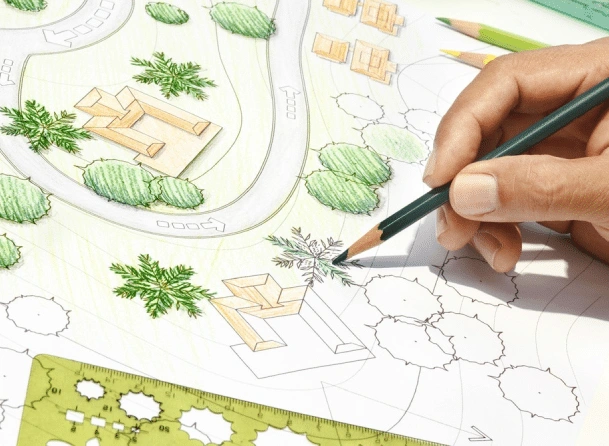
We don’t design for homeowners. Our clients are the professionals building Charleston at scale—the people who need a landscape architecture partner that can keep pace with a fast-moving project, coordinate across disciplines, and deliver permit-ready plans.
- Land developers managing entitlement, site planning, and community amenity design across large mixed-use and residential projects
- Civil engineers who need a coordinated landscape and irrigation package that integrates cleanly with their grading, drainage, and utility plans
- Architects working on commercial, hospitality, and multifamily buildings that require DRB-compliant landscape plans and a unified site design
- Design-build contractors who need constructable plans delivered on schedule and spec’d for real-world installation
Designing With the Lowcountry’s Ecology in Mind
Charleston’s landscapes aren’t just a backdrop—they’re working ecological systems. Marshes, tidal creeks, maritime forests, and coastal prairies all play roles in water quality, wildlife habitat, and the long-term resilience of the built environment.
Our planting selections prioritize native and regionally adapted species that support pollinators and local ecology. We design vegetated buffers along waterways and marsh edges that filter stormwater runoff before it reaches the Ashley or Cooper Rivers. We preserve existing tree canopies where the site allows and select deep-rooted species in areas prone to erosion. These design decisions hold up over time and reflect well on every project they’re part of.
Understanding Charleston’s Regulatory Environment
Projects in Charleston move through multiple layers of review. Depending on your project location and type, landscape plans may be subject to:
- City of Charleston Design Review Board (DRB): Required for projects on designated corridors citywide. The DRB reviews landscape plans alongside architecture and site design as part of Preliminary and Final Review phases.
- Board of Zoning Appeals – Site Design (BZA-SD): Has jurisdiction over tree protection, landscaping, and other site-related zoning regulations.
- Technical Review Committee (TRC): Coordinates site plan review across Planning, Zoning, Engineering, Stormwater, and other city departments.
- Charleston County ZLDR: For projects in unincorporated Charleston County, the Zoning and Land Development Regulations govern open space, landscaping, and site development standards.
- Coastal and wetland buffers: Properties near marshes, wetlands, or tidal creeks are subject to Special Protection Area requirements that directly affect site layout and planting design.
We’ve worked through all of these processes. Knowing which agencies are reviewing your plans—and what they’re looking for—is part of how we keep your project on schedule.
Frequently Asked Questions — Landscape Architecture in Charleston, SC
Yes. Most commercial and multifamily projects require a landscape plan as part of the site plan package submitted to the City of Charleston or Charleston County for review. Projects on DRB-designated corridors require additional landscape documentation as part of the design review process.
A tree disposition plan documents the existing trees on a site, identifies which will be preserved and which require removal, and specifies protection measures and replacement plantings. In Charleston, any project impacting Grand Trees or Protected Trees requires this documentation before receiving permits. We recommend addressing tree compliance in the earliest phases of site planning to avoid costly redesigns later.
Yes—that’s the standard on most of our projects. We work as an integrated part of the project team, coordinating with civil, architectural, and MEP disciplines throughout design development and construction documentation.
Yes. We work on projects in both jurisdictions. Charleston County operates under the Zoning and Land Development Regulations (ZLDR) administered by the County Zoning and Planning Department, which has different standards and review processes than the city. We know both environments.
The earlier, the better—especially in Charleston. Tree disposition, stormwater integration, coastal buffer compliance, and DRB design standards all affect site layout decisions. Bringing us in at the site planning or schematic design phase gives you the most flexibility and avoids redesign costs downstream.
Work With a Landscape Architecture Firm That Knows Charleston
Evergreen Design Group has been a licensed landscape architecture firm for 21 years. We’re headquartered in Bluffton, SC, and we’re deeply familiar with how development works—and what it takes to get permitted—throughout the Charleston metro. If you have a project in Charleston County—whether it’s a mixed-use development on the upper peninsula, a large residential community in West Ashley, a waterfront project on Daniel Island, or a commercial site in Mount Pleasant or North Charleston—we’re ready to get started.
Contact Us— or reach us directly at (800) 680-6630.
Get in Touch with Us
Interested in transforming your outdoor space? Fill out the form below, and our team will get back to you soon.